At first, most people ignore a hurting knee. A little discomfort after a long drive, a pain after shovelling the driveway or a pang on the stairs rarely seems worth a visit. Sometimes that sense is correct, and the soreness passes in a few days. Other times the same pain persists, recurs or slowly modifies the way you walk and move. At Integrated Health Centre, we hear from patients who booked after waiting months to get in and wish they’d come in sooner. Knowing what indications to look out for and recognizing them makes it easier to know whether knee pain treatment in Pembroke is the right plan of action to take next.
When Knee Pain Is More Than a Passing Ache
Short-lived soreness after a new activity or a long day on your feet is common. The knee carries much of your body weight with every step, so it is normal for it to feel tired after heavy use. What matters is the pattern. Pain that lasts longer than a few days, keeps coming back, or gets steadily worse is your body’s way of signalling that something is not settling on its own.
Pay attention to your knee and how it behaves throughout the day. Stiffness that takes a long time to ease in the morning, swelling that occurs after activity, or pain that is accompanied by a grinding or clicking of the knee are all reasons to have it looked at. Weakness and instability are also good reasons to have it checked out. These symptoms are concerning, but they do not always mean that something is seriously wrong. These symptoms often mean that the joint and the tissues surrounding it need an evaluation.
Potentially many different issues can cause these symptoms. These issues may include overuse from sports or running, irritation of the kneecap, injury to a ligament or meniscus from a fall or twist, and slowly progressive changes to the joint from osteoarthritis. Worldwide, the knee is the most common site of osteoarthritis. Because of the many different potential causes of knee symptoms, the right treatment plan depends on finding the root cause of your pain rather than guessing.
Changes in How You Move Matter Too
Knee pain rarely stays contained to the knee. When one joint hurts, people naturally start to compensate. You might lean on the railing more, step down the stairs one at a time, shift your weight to the other leg, or quietly give up activities you enjoy. These adjustments can feel harmless, yet over time they may place extra strain on your hips, lower back, or opposite knee.
Some patterns we look for during an assessment include:
- Limping or favouring one leg after sitting
- Avoiding stairs, kneeling, or squatting
- Pain that disrupts sleep or wakes you at night
- A knee that locks, catches, or gives way
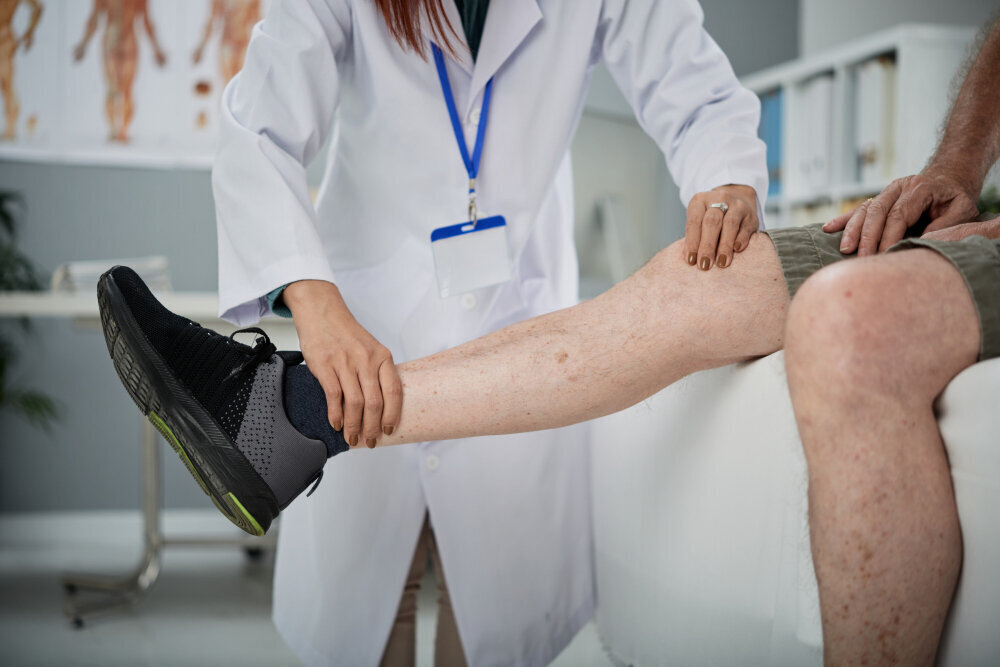
If any of these sound familiar, an assessment can help identify what may be driving your symptoms. We look at how your knee moves, how your hips, ankles, and feet share the load, and how your work and daily routine may be adding stress to the joint.
How Our Team Responds to Knee Pain
Once we get a better picture, we develop a plan based on what we find, not a one-size-fits-all routine. Depending on your needs, treatment may involve Physiotherapy to enhance strength and control of movement, Chiropractic Care to address joint restriction around the knee, hip and lower back, and Massage Therapy to relieve stress in the surrounding muscles. Supportive alternatives such as Bioflex Laser Therapy, Shockwave Therapy and Orthotics may be added as appropriate, and patients recuperating from an accident may progress via a structured Rehabilitation program.
Having all these services under one roof means that everyone involved in your care is working from the same information. That coordination can be especially helpful for individuals seeking therapy for knee pain in Pembroke following a sports incident, a winter tumble, or years of slow deterioration. Our service is designed to supplement, not replace, the advice you may receive from your physician.
Some symptoms call for faster action. If your knee pain comes with a hot, red, swollen joint and a fever, a visible deformity after an injury, an inability to put any weight on the leg, or new pain and swelling in the calf, seek emergency medical care right away.
A sore knee does not always need professional care, but pain that lingers, returns, or changes how you move is worth taking seriously. Addressing it early may help you avoid the compensations that add strain elsewhere and keep you doing the things you enjoy, from walking the dog to getting back on the ice. If your knee has been holding you back, book an assessment online or start with a consultation to talk through your options.
References
- Bannuru, R. R., Osani, M. C., Vaysbrot, E. E., Arden, N. K., Bennell, K., Bierma-Zeinstra, S. M. A., Kraus, V. B., Lohmander, L. S., Abbott, J. H., Bhandari, M., Blanco, F. J., Espinosa, R., Haugen, I. K., Lin, J., Mandl, L. A., Moilanen, E., Nakamura, N., Snyder-Mackler, L., Trojian, T., Underwood, M., & McAlindon, T. E. (2019). OARSI guidelines for the non-surgical management of knee, hip, and polyarticular osteoarthritis. Osteoarthritis and Cartilage, 27(11), 1578–1589.
- GBD 2021 Osteoarthritis Collaborators. (2023). Global, regional, and national burden of osteoarthritis, 1990–2020 and projections to 2050: A systematic analysis for the Global Burden of Disease Study 2021. The Lancet Rheumatology, 5(9), e508–e522.