Sports Injury Treatment In Pembroke
A sports injury rarely happens at a convenient time. Whether it came from an awkward landing at the rink, a rolled ankle on a trail, a pulled hamstring in the first sprint of the season, or weeks of the same repeated movement finally catching up with you, the questions are usually the same. What did I actually injure, how long is this going to take, and what can I safely do in the meantime? At Integrated Health Centre, our sports injury treatment approach starts with answering those questions properly, so your care matches your injury rather than a generic protocol.
You do not need to be a competitive athlete for this to apply. We see hockey and soccer players, runners, hunters, weekend golfers, students in school sports, tradespeople whose work is its own kind of training load, and people who simply picked up a new activity and asked their body to do something it was not yet conditioned for. What matters is the mechanism of the injury and the tissue involved, not the level you play at.
Key Takeaways
- Our sports injury treatment approach combines assessment, hands-on care, and progressive rehabilitation, so both the injured tissue and the movement pattern behind it are addressed.
- Sprains, strains, and overuse injuries make up the majority of what we see in our Pembroke clinic.
- Your plan may draw on Physiotherapy, Chiropractic Care, Massage Therapy, Rehabilitation, and Medical Exercise (MedEx), coordinated under one roof.
- Research on soft tissue injury supports brief protection followed by guided loading rather than extended rest.
- Return to sport is staged and reassessed, with attention to the strength and control deficits that can make a repeat injury more likely.
Sports Injuries By The Numbers
Sport is one of the most common settings for injury in Canada, especially among younger athletes. Statistics Canada analysis of Canadian Community Health Survey data found that two out of three activity-limiting injuries among people aged 12 to 19 were linked to sports, more than twice the proportion among working-age adults (Billette & Janz, 2011).
Sprains and strains were by far the most common type of injury reported, at roughly half of all cases, followed by fractures and broken bones at 17% (Billette & Janz, 2011). That distribution lines up with what walks through our doors. Most sports injuries involve soft tissue rather than bone, which is why an assessment of movement, strength, and joint stability matters as much as ruling out a fracture.
Ankles carry a large share of that load. An evidence-based clinical guideline on ankle sprains reports that about 40% of all traumatic ankle injuries happen during sport, and that a substantial number of people who sprain an ankle go on to experience recurring sprains or a lasting sense of instability (Vuurberg et al., 2018). That is one of the clearer arguments for having an injury assessed rather than waiting it out, particularly if it is not the first time.
None of this diagnoses your injury. It does explain why two athletes with pain in the same joint can need quite different plans, and why the details of how an injury happened are worth talking through carefully.
Common Sports Injuries We See
Sports injuries fall into two broad groups. Acute injuries happen in a moment, with a clear mechanism such as a tackle, a landing, or a sudden sprint. Overuse injuries build gradually as training volume outpaces recovery. Both respond better to care that identifies the tissue involved and the load that caused the problem. The presentations we treat most often include:
-
Ankle Sprains
Rolled or inverted ankles from cutting, landing, or uneven ground, often with swelling and difficulty bearing weight.
-
Knee Injuries
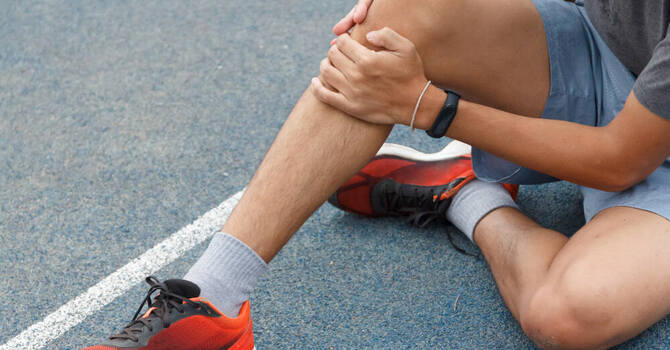
Pain, swelling, or a sense of the knee giving way after twisting, a direct blow, or repeated running and jumping loads.
-
Shoulder And Rotator Cuff Injuries
Weakness, pinching, or pain reaching overhead and behind the back, common in throwing, swimming, and overhead lifting.
-
Muscle Strains
Hamstring, calf, groin, and quadriceps strains from sprinting, sudden acceleration, or a warm-up that did not match the demand.
-
Tendon Overuse Injuries
Achilles, patellar, and elbow tendon pain that builds over weeks, is stiff at the start of activity, and lingers afterward.
-
Foot And Heel Pain
Plantar heel and arch pain aggravated by running surfaces, footwear, or foot mechanics that place uneven load through the tissue.
Two athletes can arrive with the same complaint and need very different care. A hamstring strain in a sprinter who missed a warm-up is a different problem than recurring hamstring tightness in someone with limited hip mobility and a long driving commute. Our clinicians look at the injury itself, then at the joints above and below it, your strength and control through the movement, your training history, and the demands of your sport and your work.
Where foot mechanics appear to be contributing to lower limb pain, Foot Care and Orthotics assessments are available in the same building, which keeps the process simpler than chasing referrals across town.
Early Care After A Sports Injury
What happens in the first few days after an acute injury shapes the weeks that follow. Sports medicine thinking has moved away from prolonged rest and ice toward protecting the area briefly, then reintroducing movement and load in a controlled way.
An editorial in the British Journal of Sports Medicine proposes PEACE and LOVE as a framework for soft tissue injury care. The first few days emphasize short-term protection, elevation, compression, and patient education, followed by gradual loading, optimism, pain-free cardiovascular activity, and exercise as healing progresses. The authors note that prolonged rest can compromise tissue quality, and that anti-inflammatory medication may interfere with the early healing response, which makes these choices worth discussing with a clinician rather than defaulting to them (Dubois & Esculier, 2020).
We work from the same principle. Instead of waiting for pain to disappear entirely before doing anything, we look for what you can do safely now and build from there. In practice that often means protecting the injured tissue for a short period, keeping the rest of your body moving, and starting graded loading as soon as it can be tolerated. Our care is designed to complement the guidance you receive from your physician, and we can advise when a physician assessment or imaging may be appropriate alongside your care with us.
A Team Approach To Sports Injury Treatment
One advantage of a multidisciplinary sports injury clinic in Pembroke is that your plan is not limited to a single perspective. Depending on what your assessment shows, care may draw on Chiropractic Care, Physiotherapy, Massage Therapy, Rehabilitation, and Medical Exercise (MedEx), with our providers communicating across the plan rather than working in isolation.
Sports physiotherapy typically focuses on restoring range of motion, rebuilding strength through the injured tissue, and retraining the balance and control that tend to fade after an injury. This is where the progression matters most. Loading a healing tendon or ligament too aggressively can set you back, while loading it too cautiously can leave you cleared for sport on paper but underprepared for the first hard session.
Chiropractic care can address joint restriction and the mechanics feeding into your symptoms. A sports injury chiropractor assessment may look at how the hip, spine, or foot is influencing the joint that actually hurts, since the site of pain is not always the source of the problem. Massage Therapy can help with tissue tolerance and the guarding that builds up around an injury, and Medical Exercise (MedEx) gives us a supervised setting to progress strength work rather than handing you a sheet and hoping for the best.
Where symptoms are stubborn, supportive options such as Bioflex Laser Therapy, Shockwave Therapy, and Electro Magnetic Therapy may be considered within the broader plan rather than as standalone fixes. Counselling is also available for athletes finding the psychological side of a long recovery difficult, which the research on soft tissue injury recognizes as part of the picture rather than an afterthought.
Signs To Seek Care Sooner
Plenty of minor sports injuries settle on their own within a few days. Certain signs suggest it is worth having the injury looked at promptly rather than training through it. These include:
- Inability to put weight through the limb after the injury
- Rapid swelling, significant bruising, or a pop or snap felt at the moment of injury
- A joint that gives way, catches, or locks during normal movement
- Pain that plateaus or worsens after a week or two of self-care
No single sign on this list points to one diagnosis. Together they are a reasonable prompt to have the injury assessed, both to clarify what is going on and to avoid the pattern where a manageable problem becomes a recurring one. Repeat injuries in the same spot deserve particular attention, since they often reflect a deficit that was never fully addressed the first time.
If an injury involves a head impact with loss of consciousness, repeated vomiting, worsening confusion, or an obviously deformed limb or joint, seek emergency medical care right away.
Returning To Sport Safely
Feeling better and being ready are not the same thing. Pain often settles well before strength, control, and tissue tolerance catch up, and that gap is where a lot of repeat injuries happen. The last stage of sports injury rehabilitation is about closing it.
The ankle sprain clinical guideline illustrates the principle well. It reports that functional treatment using tape or a brace combined with an exercise program is preferred over immobilization, that early exercise therapy is associated with a lower rate of recurrent sprains with a larger effect seen in athletes, and that supervised exercises focused on proprioception, strength, coordination, and function are recommended when resuming sport. It also advises identifying modifiable factors such as deficits in proprioception and range of motion and addressing them within the rehabilitation plan (Vuurberg et al., 2018).
We apply that thinking across the injuries we treat. Rather than clearing you on the calendar, we look at whether you can produce force, absorb it, change direction, and repeat the movement your sport actually demands. Progressions are staged, reassessed as you respond, and adjusted when a session tells us something new. Where taping or bracing has a role during the transition back, we discuss it as part of the plan and not as a permanent crutch.
Beyond the return itself, our team focuses on the habits that help keep you in your sport. That may include a warm-up that matches the demand of your session, guidance on managing training volume through a season, footwear and mechanics where relevant, and a short maintenance routine to hold the strength and control you worked to rebuild.
Common Sports Injuries And Our Approach
| Injury | Common Signs | Our Approach |
|---|---|---|
| Ankle sprain | Swelling, bruising, difficulty bearing weight, a feeling of instability | Graded loading with balance and proprioception retraining, plus taping or bracing support where appropriate |
| Knee pain or instability | Swelling, giving way, pain with stairs, squatting, or pivoting | Assessment of hip, knee, and foot mechanics with progressive strengthening through the painful range |
| Shoulder and rotator cuff pain | Pain reaching overhead, weakness, discomfort at night | Manual therapy paired with scapular and rotator cuff strengthening, progressed toward sport-specific load |
| Muscle strain | Sudden pain during sprinting or lifting, tightness and soreness afterward | Hands-on care early, then progressive loading toward the speed and force your sport requires |
| Tendon overuse injury | Pain that builds with training volume, stiffness at the start of activity | Load management with structured tendon loading, and Shockwave Therapy or Bioflex Laser Therapy where indicated |
Book A Sports Injury Assessment In Pembroke
If an injury is keeping you off the ice, off the trail, out of the gym, or just moving carefully through your day, our team at Integrated Health Centre can help you understand what is going on and build a plan around it. Our approach to sports injury treatment brings chiropractic care, physiotherapy, rehabilitation, and the rest of our healthcare team together, so your care reflects the full picture rather than one isolated symptom.
Reach out to our Pembroke clinic to book an assessment and get a clear next step, whether your injury happened last night or has been lingering for months.
Call (343) 947-3439
References
- Billette, J.-M., & Janz, T. (2011). Injuries in Canada: Insights from the Canadian Community Health Survey. Health at a Glance (Catalogue no. 82-624-X). Statistics Canada.
- Dubois, B., & Esculier, J.-F. (2020). Soft-tissue injuries simply need PEACE and LOVE. British Journal of Sports Medicine, 54(2), 72–73.
- Vuurberg, G., Hoorntje, A., Wink, L. M., van der Doelen, B. F. W., van den Bekerom, M. P., Dekker, R., van Dijk, C. N., Krips, R., Loogman, M. C. M., Ridderikhof, M. L., Smithuis, F. F., Stufkens, S. A. S., Verhagen, E. A. L. M., de Bie, R. A., & Kerkhoffs, G. M. M. J. (2018). Diagnosis, treatment and prevention of ankle sprains: Update of an evidence-based clinical guideline. British Journal of Sports Medicine, 52(15), 956–970.
.png)